


The continued rise of advanced factory automation equipment has placed new demands on servo driven systems. With servo and DC motors powering increasingly rigid, high-speed machinery, the risk of costly jams or collisions has grown significantly. Unchecked torque overloads can result in catastrophic equipment damage, extended downtime, and lost production. For today’s design engineer, implementing effective torque overload protection is no longer optional—it is essential. Among the available solutions, mechanical torque limiters, and specifically ball detent style, provide the fastest, most precise mechanical safeguard against overload conditions.
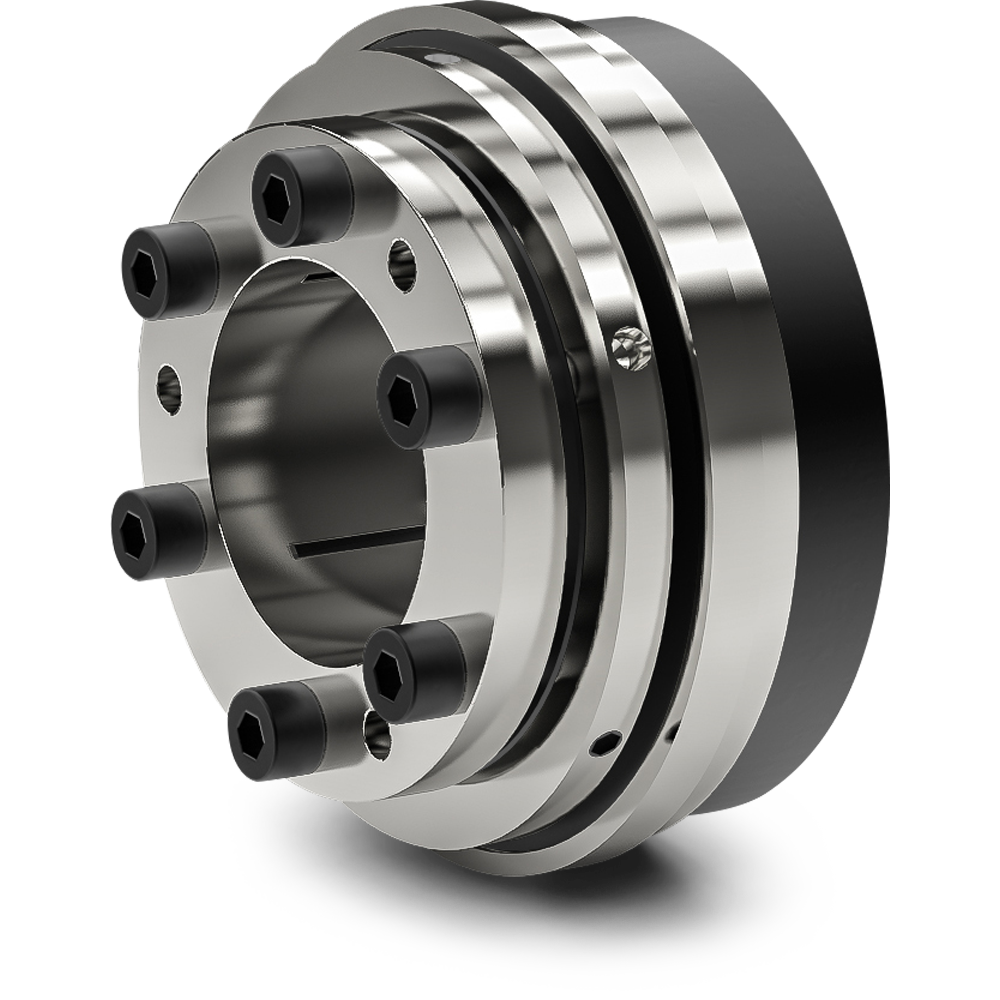
The Importance of Torque Limiters
Most drive systems—comprised of motors, gearboxes, belts, sprockets, and shafts—are designed to transmit only the torque necessary for normal acceleration and loading cycles. When an unplanned and rapid driveline deceleration occurs as a result of an equipment jam or crash, far greater torques than the components were designed to handle can easily occur. Programming current limits into the drive system to prevent excessive torque from being generated by the motor is crucial, however this does not account for the energy that has already been delivered to the running system in the form of high-speed shaft rotation.
Consider that acceleration (deceleration) multiplied by inertia equals torque. If the stopping time resulting from a jam or collision is a fraction of the planned acceleration and deceleration rate of the servo axis, then the resulting torque will also be a multiple of the expected application torque.
Mechanical torque limiters are a part of the driveline itself, and disconnect to allow energy to be released before damaging torque levels propagate through the system. Specifically precision ball-detent torque limiters facilitate and extremely rapid release (1-3 milliseconds) to prevent costly damage and downtime.
The Ball Detent Principle
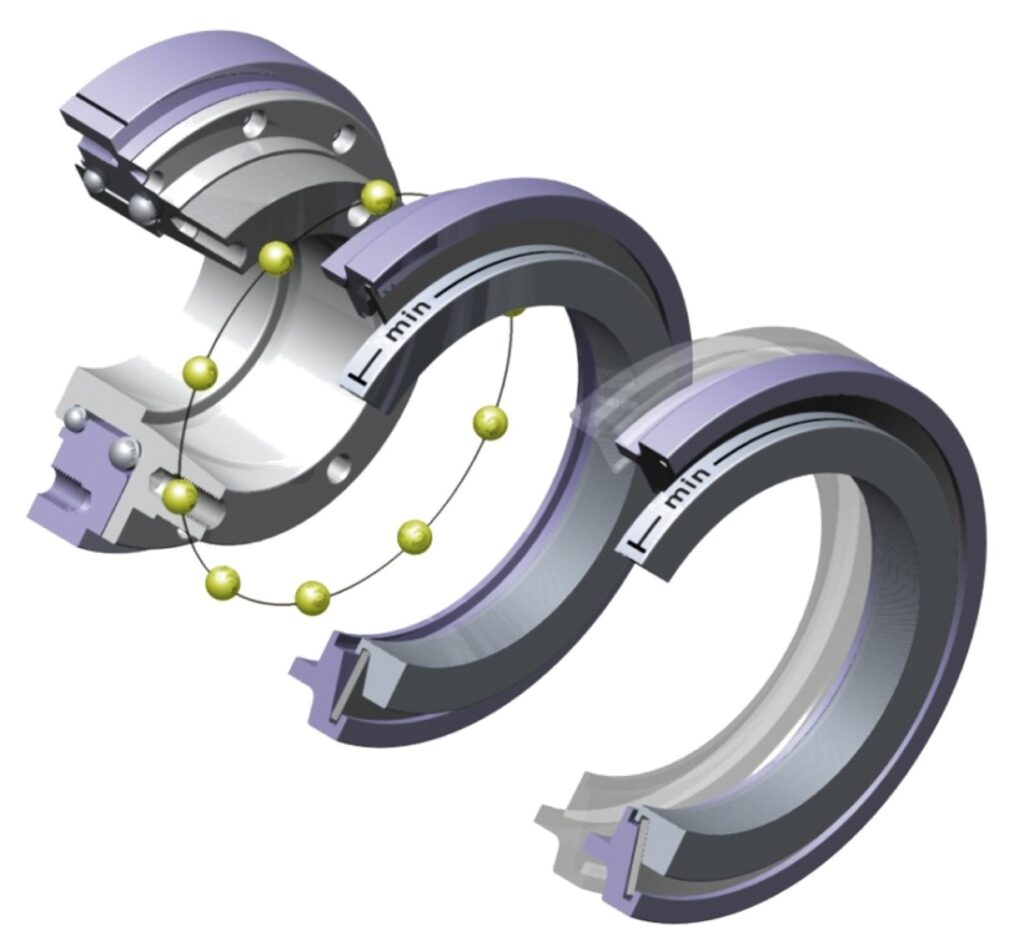
R+W’s torque limiters employ a ball detent mechanism consisting of precision-hardened steel balls seated in conical detents and held in place by a preloaded spring assembly.
- Under normal operation, torque is transmitted cleanly and without backlash.
- When torque exceeds the calibrated threshold, the balls roll out of the detents, instantly separating driving and driven components.
- Spring preload is adjustable, allowing precise torque calibration to the application.
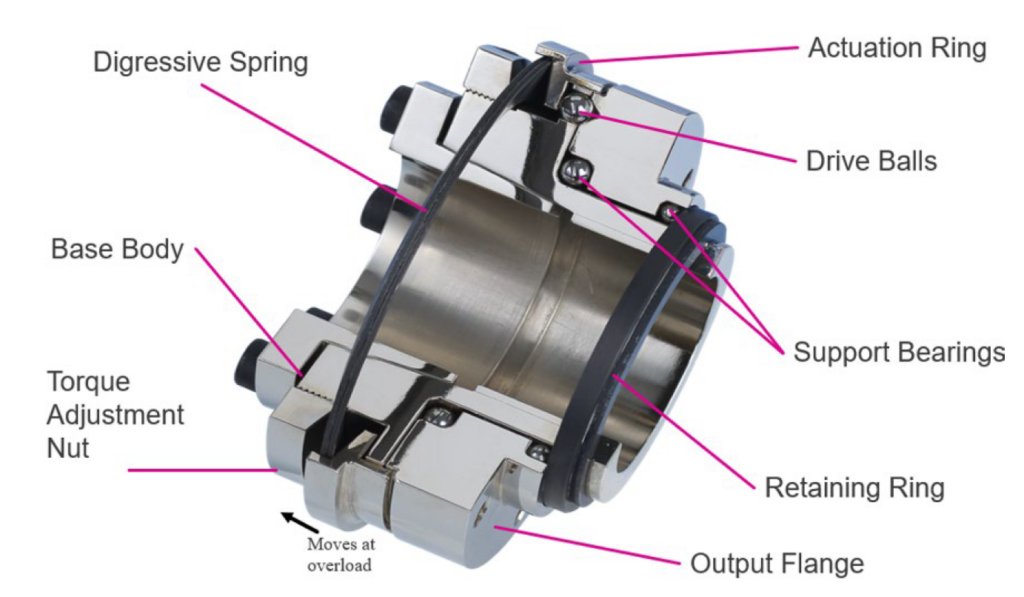
This construction provides backlash-free operation, low moment of inertia, and repeatable disengagement, making it ideal for automation applications requiring rapid accelerations, decelerations, and directional changes.
Functional Styles of R+W Torque Limiters
To address a wide range of application requirements, R+W torque limiters are available in three main functional styles, all within a standardized, compact design envelope:
- Single Position Re-Engagement: Re-engages automatically in the exact angular position due to residual spring pressure after 360° rotation. Most common option and essential for applications requiring precise timing registration to facilitate homing of the system after disengagement.
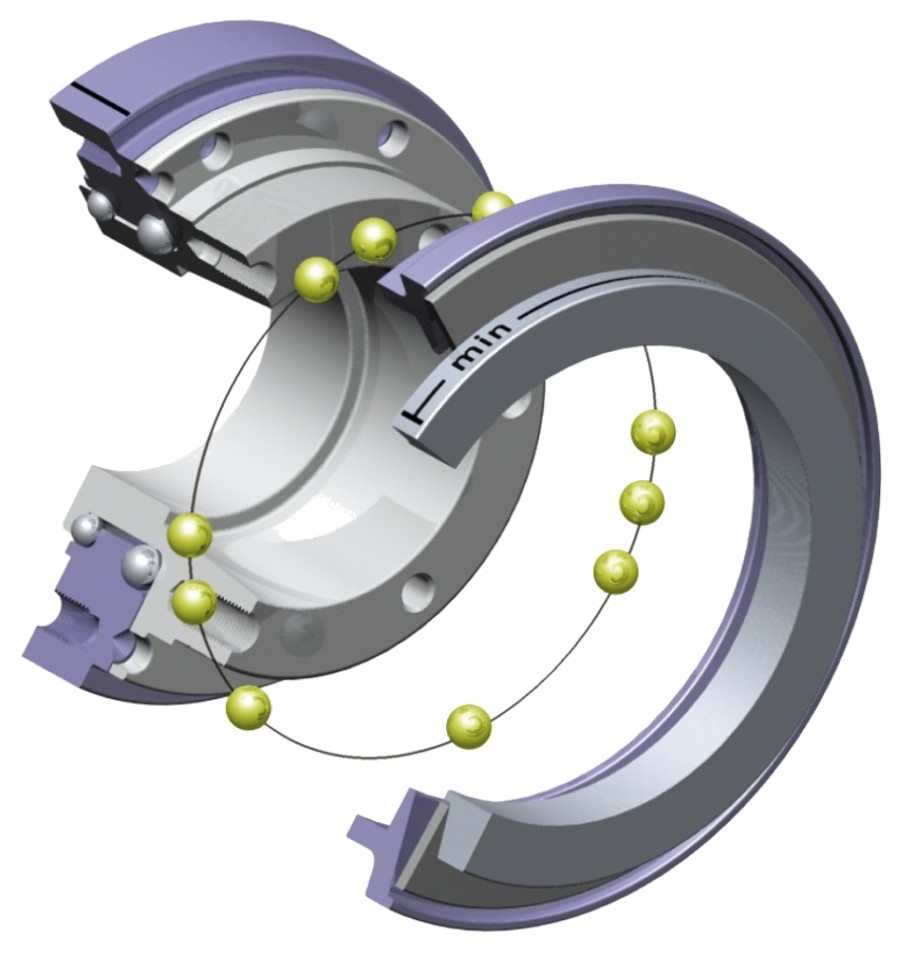
- Multi Position Re-Engagement: Re-engages automatically at multiple angular positions (typically every 60°, with custom options available). – Useful in case of application downstream of large gear reductions where rotation for re-engagement is very slow, or conversely in case of rapid acceleration while re-starting from the disengaged state to ensure the ball-detent catches quickly.
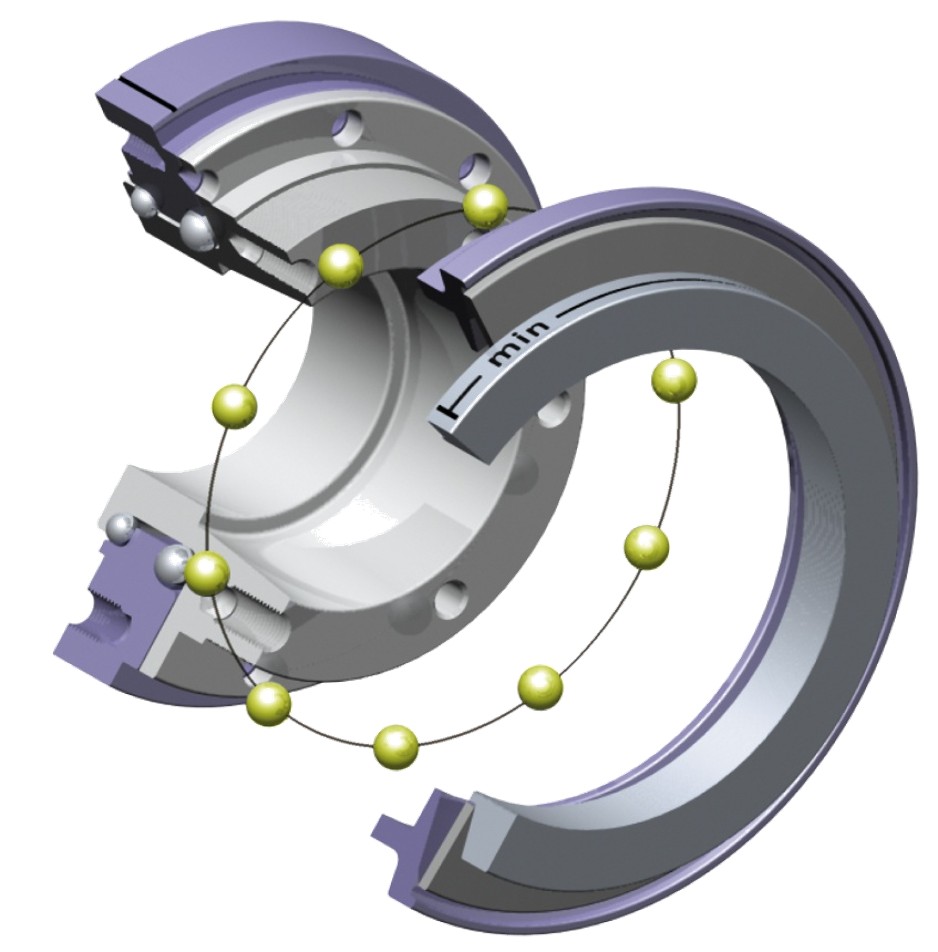
- Full Disengagement: Disconnects completely and remains disengaged until manually reset. Suited for high-speed systems to avoid high levels of friction in the ball-detent system while the driveline coasts down to a stop.
Typical Configurations
Typical servo torque limiter configurations include integrated bellows couplings with high torsional stiffness for dynamic precision applications, integrated elastomer insert couplings for vibration damping and shock absorption, and simple flange outputs for attaching to sprockets, pulleys and gears.

Performance Advantages
R+W torque limiters deliver several performance benefits:
- Ultra-fast reaction: disengagement in 1–3 ms, which is faster than controllers can respond.
- Compact and lightweight: minimal mass moment of inertia for high-speed servo drives.
- Backlash-free design: critical for precision servo motion control in automation equipment.
- Durability: precision-hardened components withstand repeated overloads without degradation.
- Design flexibility: multiple operating styles available in one dimensional package.
Additionally, R+W’s patented manufacturing process achieves up to 10% higher torsional stiffness compared to other ball detent systems.
Conclusion
Machine jams and collisions are inevitable, often occurring during peak production. Torque limiting safety couplings act as a cost-effective insurance policy, preventing catastrophic failures, minimizing downtime, and ensuring production continuity.
By combining compact design, ultra-fast response, and application-specific functionality, R+W torque limiters provide engineers with a reliable, precise, and versatile safeguard for modern automated systems.