


What to specify, what to have ready for an RFQ, and how to compare precision jaw couplings. A practical 2026 guide from R+W.
AT A GLANCE
- A jaw coupling is a low cost part whose failure stops the whole machine, so sizing matters more than unit price.
- Have seven data points ready: torques, temperature, starts, load type, inertias, shafts and environment.
- Precision versions are backlash free, machined from solid round stock and can run up to 60,000 rpm; generic versions may not.
- Correctly sized and aligned, precision jaw couplings are maintenance free with a very long service life.
QUICK ANSWER
To get the right jaw coupling, specify the application first: drive torque, peak torque, temperature, starts per hour, load type, inertias, shaft sizes and any ATEX or isolation needs. It can then be sized per DIN 740. Correct sizing, not purchase price, decides lifetime cost and downtime.
When should you specify a precision jaw coupling?
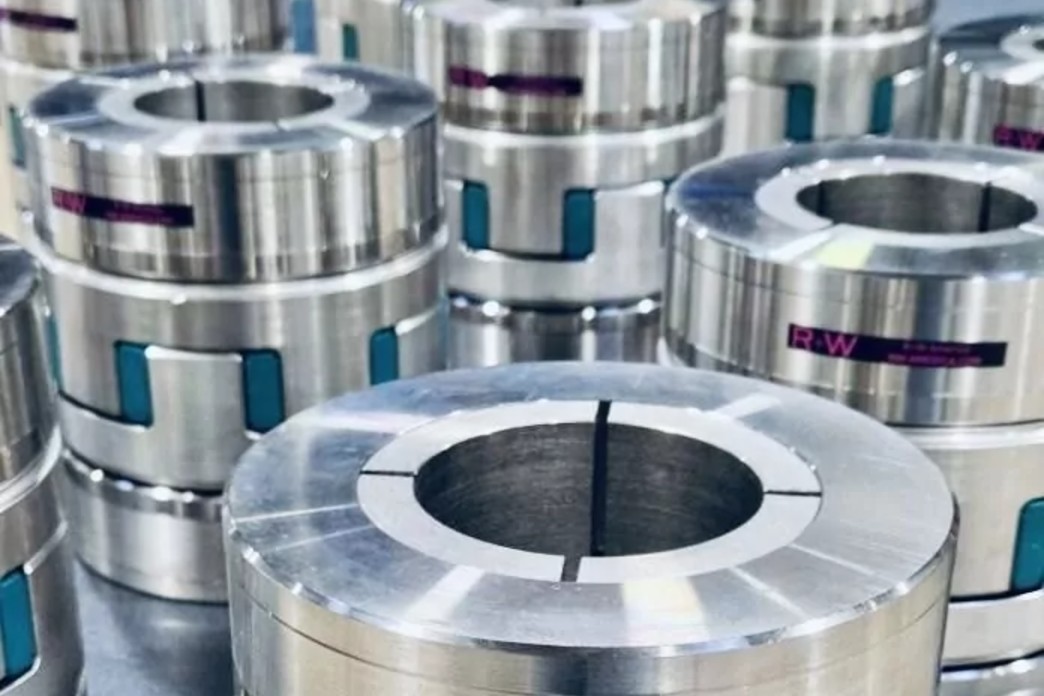
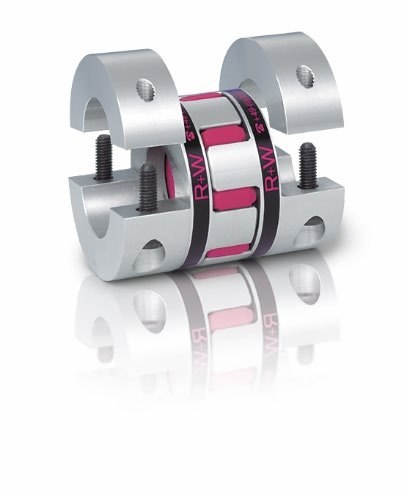
Specify a precision elastomer jaw coupling when a drive needs backlash free torque transmission plus vibration damping. Jaw couplings, also called spider couplings, use an elastomer insert between two hubs to transmit torque, absorb torque impacts and compensate for small misalignment.
- Drives with vibration or impact loads that should not reach the motor or gearbox
- Servo and motion axes needing backlash free transmission
- Applications needing electrical isolation between shafts
- ATEX zones 1 and 2, using a conductive insert
R+W precision elastomer couplings cover approximately 2 Nm to more than 25,000 Nm, with bores from 3 mm to 170 mm. Browse the precision elastomer coupling range or the heavier duty industrial elastomer couplings.
How does a jaw coupling compare with other precision couplings?
A jaw coupling trades some torsional stiffness for damping and electrical isolation. Bellows and disc couplings are stiffer but do not damp vibration the same way.
| Need | Precision jaw coupling | Stiffer metal coupling (bellows/disc) |
|---|---|---|
| Vibration and shock damping | Yes, via the elastomer insert | Limited |
| Backlash free | Yes, preloaded insert | Yes |
| Electrical isolation | Yes, except conductive type D | Typically no |
| Torsional stiffness | Set by insert hardness | Higher |
| Maintenance | Maintenance free within misalignment limits | Maintenance free within limits |
What information do you need to select a jaw coupling?
You need the data the DIN 740 sizing method uses. With it, you or a supplier can confirm size and insert in one pass instead of several attempts.
- Rated drive torque (Nm)
- Peak drive torque (Nm)
- Operating temperature at the coupling
- Starts per hour
- Load characteristic: uniform, non-uniform or highly dynamic
- Moments of inertia of the driving and driven sides (kgm²) or an estimate of the ratio
- Shaft diameters and preferred hub style (clamping, split, keyed, keyless)
- Environment: Corrosion, ATEX zone, etc.
- Application speed
BUYER TIP
Split clamping hubs allow radial mounting without moving the motor or load.
Hub style affects installation time and shaft damage risk. See the clamping hub coupling options available and our comparison of keyless vs keyed shaft connection cost.
Why does correct sizing lower total cost of ownership?
Correct sizing lowers total cost because an undersized insert fails early and stops the machine. The coupling itself is a small line item; the downtime and labor to replace it are not.
Temperature alone can make an “on-paper” match fail. In R+W’s example, an insert rated 60 Nm carries only 43 Nm at 60°C, so an 84 Nm rated coupling is needed for a 60 Nm drive. Shocks, reversing loads and frequent starts add further margin.
In a full R+W worked example, an EK2/300/A (650 Nm maximum torque) would be qualified for a 260 Nm peak drive with a required maximum of 594.72 Nm. Sizing like this is what keeps a coupling in the “install and forget” category.
- Maintenance free when misalignment stays within the insert’s limits
- Very long service life because the elastomer flexes instead of rubbing
- Calibrated inserts reduce bearing loads during assembly and axial movement
FREE DOWNLOAD · DIN 740 SIZING WORKBOOK
Check the size before you send the RFQ
Our DIN 740 sizing workbook walks through the same temperature, start and shock/load factors used above, so you can check the rated and maximum torque ratings for your application. Attach the completed workbook to your quote request and our applications engineers can confirm size and insert in one pass.
Which specification mistakes cost buyers the most?
The costliest mistakes are the ones that leave the coupling undersized for real operating conditions. Each one below is avoidable:
- Matching coupling rated torque to motor rated torque, with no temperature derating
- Ignoring shock or reversing loads, which must be checked against maximum torque
- Leaving out starts per hour; every start applies peak torque as the load inertia accelerates
- Defaulting to the hardest insert for “safety” and losing the damping and flex the drive needed
- Forgetting electrical requirements, such as isolation for sensitive drives or a conductive insert for ATEX zones
High-cycle motion axes deserve special attention. DIN 740 offers no guidelines above 240 starts per hour, yet R+W precision elastomer couplings routinely run thousands of starts per hour. Except in extreme cases, R+W has found a start factor of 1.5 reliable when the coupling frequently sees maximum torque.
+ Engineering tip: If a specification arrives without any information about temperature or motion profile, ask how the size was chosen before you release the design.
How do you choose the insert?
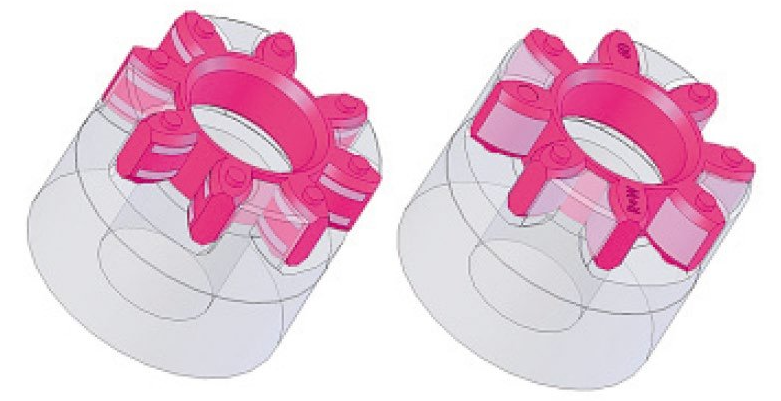
Choose the insert that matches the load, not the hardest one available. The standard 98 Sh A insert suits most applications; softer and harder inserts solve specific problems.
| If your application has… | Typical insert | Why |
|---|---|---|
| General duty, mixed damping and load | Type A, 98 Sh A | 2–20,000 Nm, –30°C to +100°C |
| High vibration, low torque | Type C, 80 Sh A | Best damping, 2–400 Nm |
| High torque, high stiffness | Type B, 64–65 Sh D | Up to 25,000 Nm, low twist |
| Explosion-proof (ATEX zones 1 and 2) | Type D, 65 Sh D | Conductive, –10°C to +90°C |
| Temperature extremes | Type E, HYTREL | Built for extreme temperatures |
Softer is not weaker by design, and harder is not automatically better. A soft 80 Sh A insert damps vibration best but twists more under load, while a 64–65 Sh D insert is stiff and carries the most torque but damps torque impacts only to a limited degree. Make sure to match the insert to the load profile.
What separates a precision jaw coupling from a commodity part?
Process control separates them. Precision hubs are machined from solid round stock and checked on a mandrel to guarantee the assembly runs concentrically, which is why some balanced models can be rated up to 60,000 rpm.
Inserts are calibrated after molding: pressed into a master hub and heat treated so they contact the jaws over a larger area. That improves hysteresis and service life and keeps performance consistent from one unit to the next.
Why source jaw couplings from R+W?
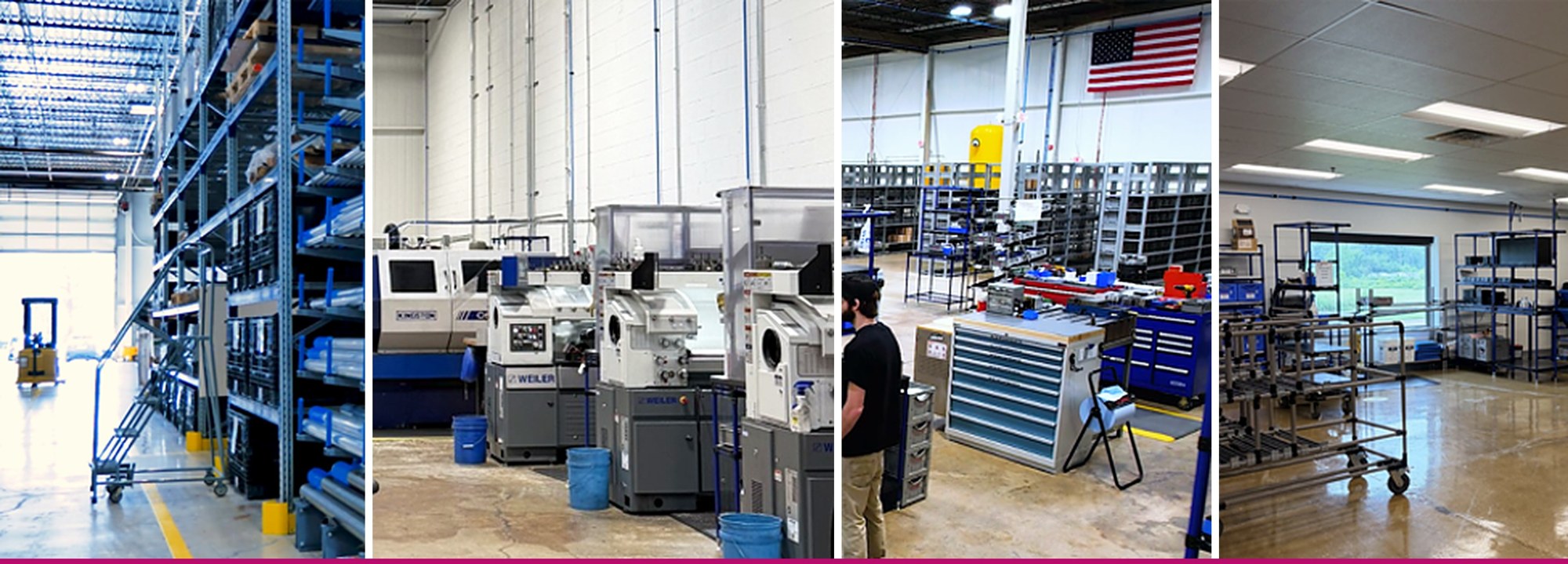
R+W supports engineers and buyers directly from West Chicago, IL, with applications engineers who can help size couplings per DIN 740. You can download catalogs from the R+W download section and pull CAD files from the configurator.
For non-standard requirements, R+W also develops special coupling solutions.
Frequently asked questions
They are the same product. A jaw coupling has two jaw hubs and an elastomer insert, called a spider, that transmits torque and damps vibration.
Send rated and peak drive torque, temperature, starts per hour, load type, driving and driven inertias, shaft sizes and hub style. Add any ATEX, isolation or speed requirements.
When misalignment is kept below the recommended maximum for the insert, precision elastomer couplings are maintenance free. The elastomer flexes rather than rubbing against the jaws, giving a very long service life.
Precision elastomer couplings cover approximately 2 Nm to more than 25,000 Nm. Bore diameters range from 3 mm to 170 mm.
Yes. Small spacers on the insert keep the hubs apart, which isolates them electrically. The only exception is the conductive type D insert, used where static must be grounded.
+ Request a jaw coupling quote
Send your application data to R+W in West Chicago, IL, and our team will recommend the right size and insert, with CAD files ready for your design.
Or call +1 630 521 9911 · info@rw-america.com · Mon–Fri, 8 AM–5 PM Central