


Seven engineering rules of thumb for picking a bellows or elastomer servo coupling, with wind-up numbers for ball screws, gantries, gearboxes and arms.

AT A GLANCE
- Bellows couplings are roughly 10x stiffer than comparable elastomer couplings. Elastomer couplings damp vibration and cost somewhat less.
- Mechanical advantage (screw lead, gear ratio) is your friend. A larger load radius works against you.
- Keep gantry line shaft error to a minimum, and check direct drive axes for servo loop stability.
QUICK ANSWER
Choose a bellows coupling when wind-up feeds straight into load position: belt-driven actuators and direct driven loads with a large radius or high inertia. Choose a precision elastomer coupling when a screw lead or gear ratio reduces the effect of wind-up, as on ball screws and gearbox inputs. Then confirm the choice with a quick torque over stiffness calculation.
Why rules of thumb help
There are many precision couplings on the market, and starting from the right default saves time. The rules below come from R+W’s application guidance. Use them to choose a starting point, then check it against your own torque, stiffness and accuracy numbers.
01 Expect about a 10:1 stiffness gap between bellows and elastomer
A metal bellows coupling is about 10x torsionally stiffer than a comparably sized elastomer coupling. Position error from wind-up scales by the same ratio.
02 Default to elastomer on ball screws
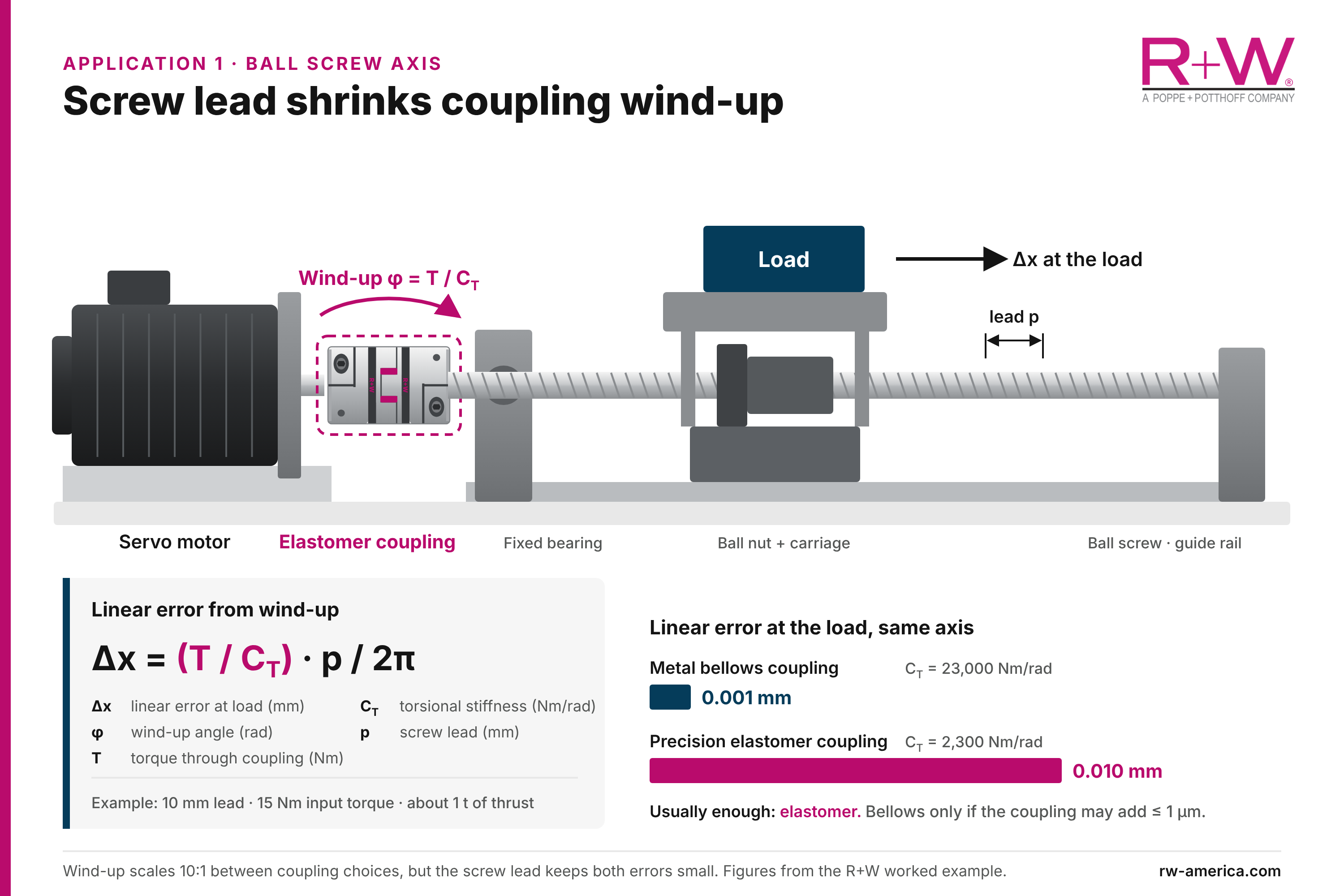
The screw lead gives a mechanical advantage, and the input torque is low. On a 10 mm lead screw at 15 Nm (1 ton of thrust), the elastomer coupling added 0.010 mm of linear error and the bellows coupling 0.001 mm. Both are acceptable for most axes.
03 Move to bellows only for extreme screw accuracy
Some ball screw axes can only allow the coupling to add about one micron (0.00004 in) of error. Those need a bellows coupling.
04 Treat belt drives as 1:1 with the load
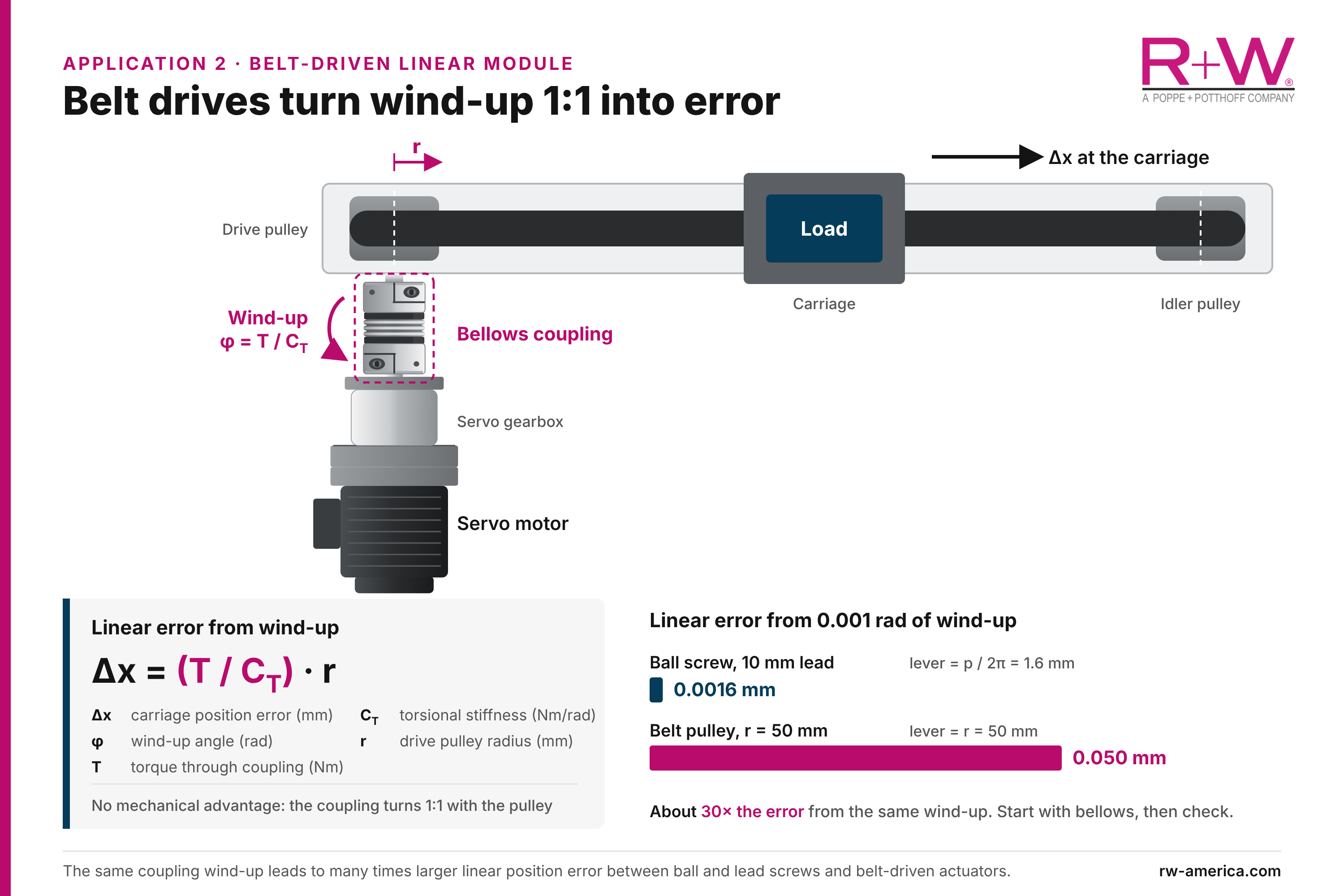
Belt driven modules have no mechanical advantage beyond the coupling, so coupling wind-up turns straight into carriage error at the pulley radius. That is also why these drives usually need a precision gearbox.
+ Not sure which rule applies to your axis? Talk to an R+W applications engineer →
05 Keep gantry line shaft error to a minimum
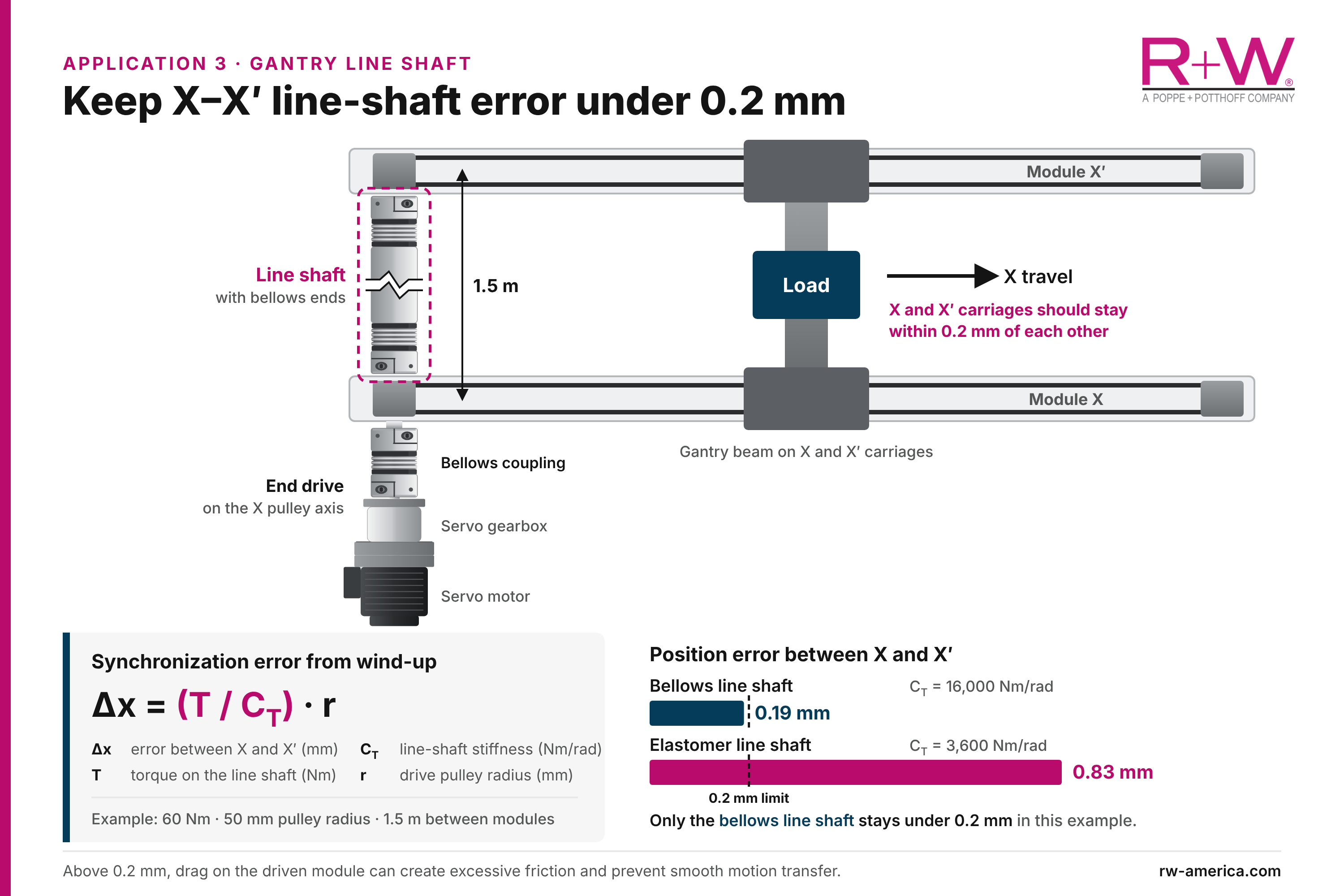
On tandem X and X′ modules, too much wind-up creates drag on linear guides. In a gantry example (60 Nm, 50 mm pulley radius, 1.5 m between modules), the bellows line shaft gave 0.19 mm of error and the elastomer line shaft gave 0.83 mm. Going slightly oversized on a line shaft can make a single end drive layout work, saving cost and complexity.
06 Try elastomer first on precision gearbox inputs
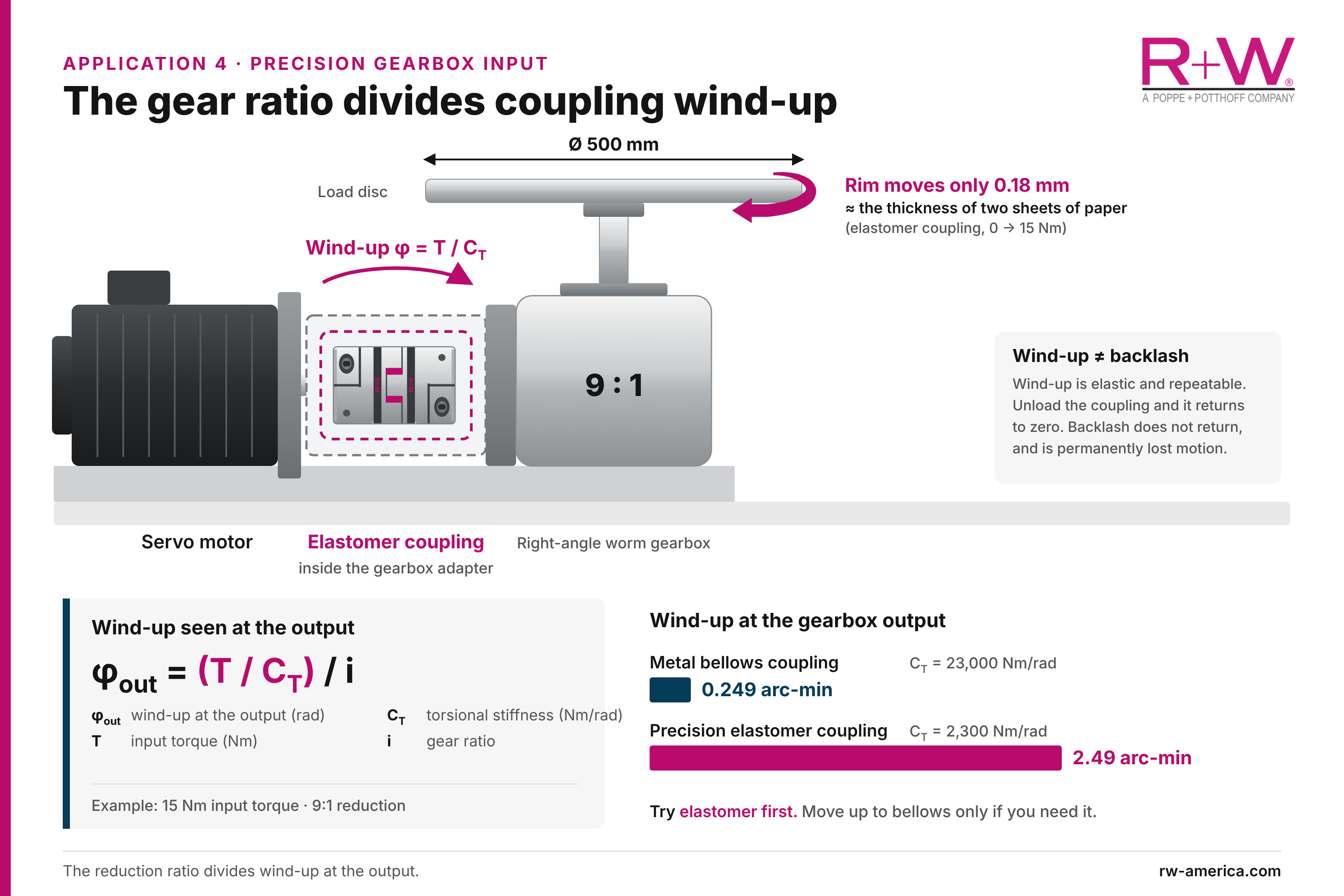
The reduction ratio divides wind-up at the output. With a 9:1 ratio at 15 Nm, the result is 0.249 arc-min for bellows and 2.49 arc-min for elastomer. On a 500 mm diameter load, the elastomer coupling wind-up moves the rim only 0.18 mm. Unlike backlash, wind-up is repeatable and returns to zero.
07 Use bellows when the load radius or inertia is large
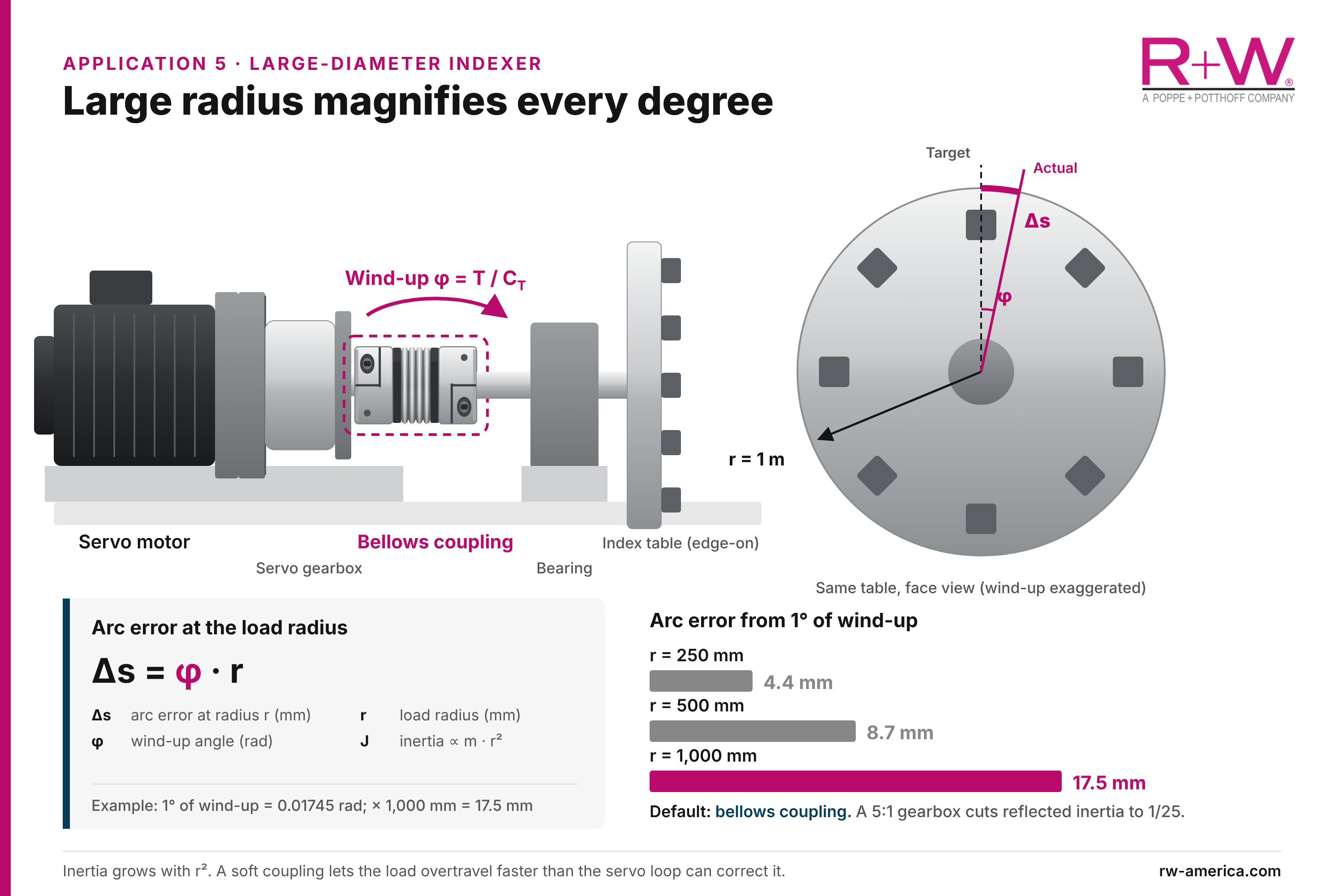
One degree of wind-up at a 1 m radius is 17.5 mm of error. Inertia also grows with the square of the radius. A soft coupling can let the load overtravel faster than the servo loop can correct, causing high frequency oscillation. A gearbox helps, since a 5:1 ratio cuts reflected inertia to 1/25th.
Bottom line
Start from the default for your application and run the torque over stiffness check. Remember that both families include several flexible element and hub designs.
Frequently asked questions
Neither is better in every case. Elastomer couplings are the usual default for ball screws, lead screws and gearbox inputs. Bellows couplings are the usual default for belt driven shuttles under significant torque and for direct driven loads with a large radius or high inertia.
A longer lead increases the linear error caused by coupling wind-up. The rough order of magnitude stays the same, though, so an elastomer coupling usually remains suitable.
A gearbox divides the input coupling’s wind-up angle at the output by the reduction ratio. It also reduces reflected inertia by the square of the ratio. Both effects lower the stiffness the input coupling needs.
+ Not sure which rule applies to your axis?
An R+W applications engineer can run the wind-up check with you and recommend a bellows or elastomer coupling for your servo axis.
Or call +1 630 521 9911 · info@rw-america.com · Mon–Fri, 8 AM–5 PM Central